


Haz click para leer el artículo en español
At UNIT, we work through collaboration. We partner with public, private, academic and civil society institutions when there is a real alignment of purpose — when shared questions, complementary capabilities and common values make the work stronger than it would be alone. That is not only how we run projects; it is how we understand public design itself. Public design rarely belongs to one organisation, one discipline or one method. It happens across institutions and forms of knowledge: inside ministries and municipal teams, in universities, through civil society organisations, in creative studios, and in the places where communities and the state actually meet.
That way of working also reflects a reframing of the problem. Much of the public conversation about “modernising the state” is still defined in terms of tasks for civil servants and politicians — as something that happens inside the machinery of government, discussed in a seminar hall, measured in internal indicators. We see it differently. Public value emerges when three actors work together, not in isolation: an agile, capable, modern state; a healthy private sector, where many actors can participate and innovate; and an active civil society.
The real challenge of public innovation as shifted from the generation of clever ideas addressing isolated problems towards building the conditions in which many actors can work on public problems together.
The hard part is that this articulation is genuinely difficult. The actors rarely meet, they think differently, and they answer to different timelines. So the real challenge of public innovation has shifted from generating clever ideas that address isolated problems to building the conditions — the trust, the shared language, the connective tissue — in which many actors can work on public problems together. Much of what we design and build is exactly that: the infrastructure of public innovation — the labs, methods, programmes through which the public sector reinvents how it works. As I’ve written before, bureaucracy is not the enemy of a vibrant public life; it is the very infrastructure that makes the common possible, and the creative bureaucrat’s task is to imagine institutions that can last without fossilising, and change without losing what makes them shared.
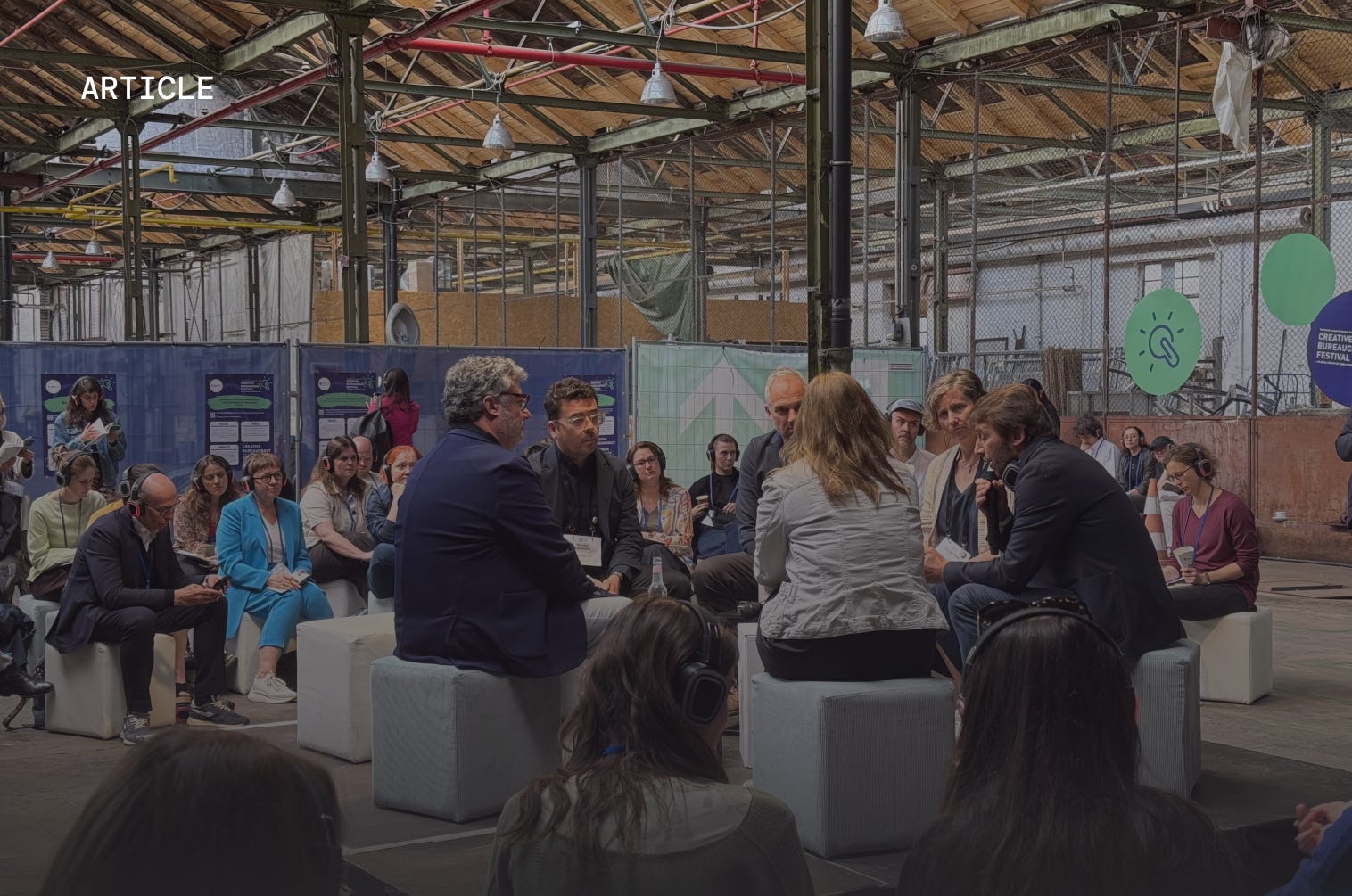
That conviction is the reason we were in Berlin this June for the Creative Bureaucracy Festival, and it is the reason we are now taking on a bigger commitment: UNIT is the regional partner for CBF LATAM, the first Latin American edition of the festival, which will take place in Santiago de Chile in 2027. This post is an attempt to explain what we did in Berlin, what it taught us, and why we believe the region needs this platform now.
The spirit of the festival: why creative bureaucracy, and why now
This year’s theme was creative bureaucracy, stronger democracy, and the festival’s opening made clear it is not just an empty slogan. Charles Landry, CBF’s co-founder, began with a personal memory: ninety years ago his father boarded a train out of Berlin, fleeing a collapsing democracy. Democracy, he reminded us, does not collapse only in parliaments or on the streets. It also collapses when institutions lose connection with the people they are meant to serve — when rules cease to protect and begin to intimidate, when administrations serve power rather than human dignity. Today, according to Charles, just over a third of citizens across OECD countries trust their national government, and when trust erodes, people start looking elsewhere: manifestations of anger or discontent rather than possible answers, simple, quick solutions rather than addressing complex problems. That is why an effective creative bureaucracy that renews trust through competence, imagination and care — is, in his words, a democratic necessity, not administrative cleverness.
Former Greek Prime Minister George Papandreou, also opening the festival, put the same idea, taking a step back. For the ancient Athenians, he said, politics was almost a revelation: the discovery that a community needs no tyrant to decide its future — that people can imagine a better future and make it happen together. In that light, creative bureaucracy can be seen as a recovery of imagination in governance. The lesson, as the recent Greek crisis so painfully reminded us, is disarmingly simple: don’t throw solutions at people; enable them to become co-creators of their future. Bureaucracy, he insisted, is precisely where democracy becomes real — or fails. When permits take years or services collapse, people don’t merely lose faith in a ministry; they lose faith in the idea that democratic government can deliver public value at all.
We went to Berlin because this conviction is ours too. Everything UNIT does stems from it.
What we did in Berlin
Our participation in the festival traces a single arc — from international practice, to our own region, to how the field learns, and to the cities and cultures where all of it actually unfolds.
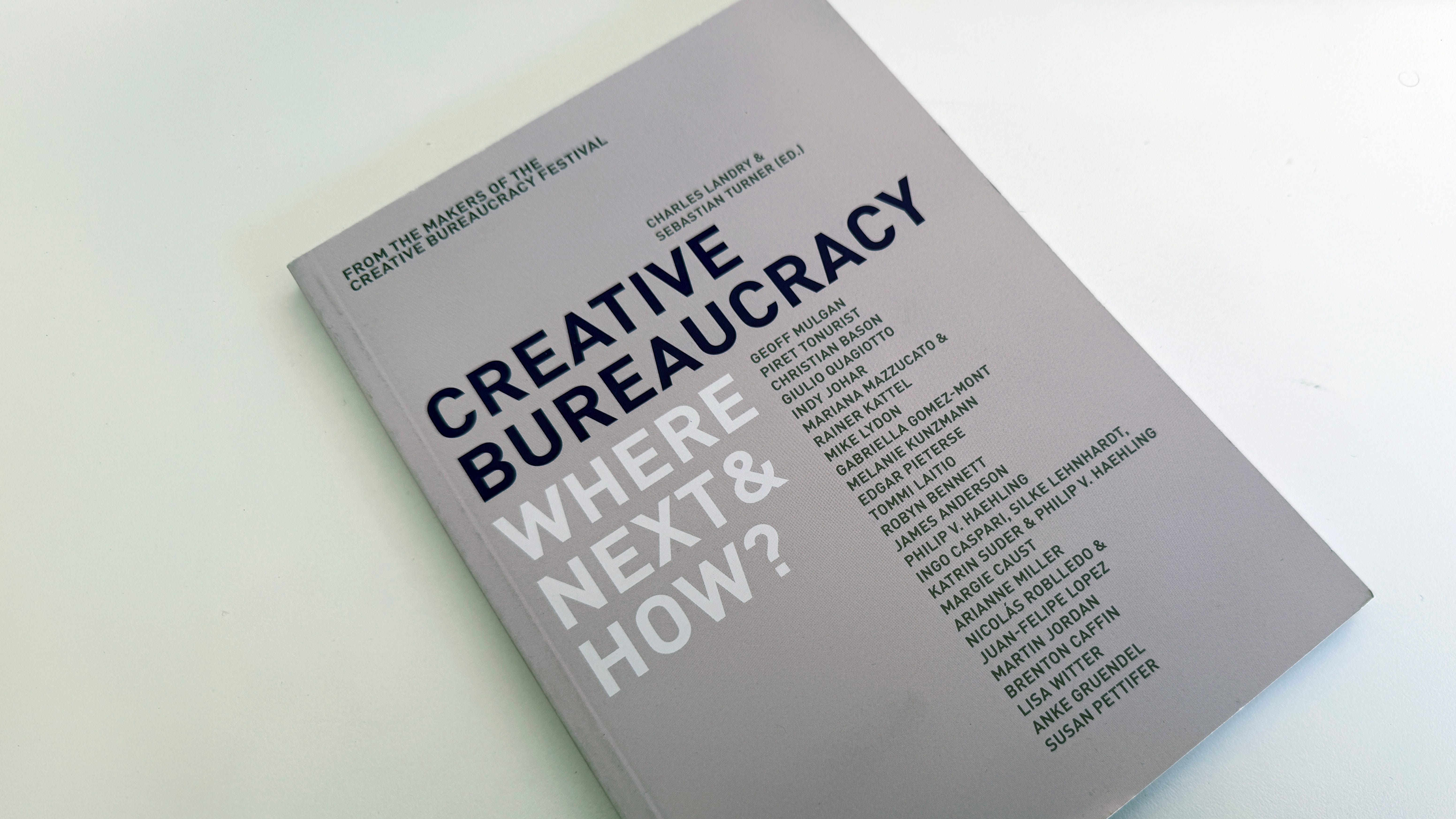
First, a reflection on international practice: we were invited to contribute to the festival’s global report. Creative Bureaucracy: Where Next and How?, edited by Charles Landry and Sebastian Turner, that gathers voices from across the field — among them Geoff Mulgan, Mariana Mazzucato, Christian Bason, Indy Johar and Piret Tõnurist. UNIT’s CEO, Juan Felipe López and I wrote a chapter: “Remaking Public Innovation Practice: Three Shifts.” There we argued that the ground beneath our field has moved faster than our methods, along three axes: a technological shift, as AI restructures the creative process itself; a cultural shift, as a toolkit, born mostly in the Global North, meets contexts it was never designed for and so has to be re-situated; and a political shift, in which democratic deliberation is not friction to be bypassed, but the very thing that makes innovation legitimate.
That last point is our through-line — we believe in a democratic answer to public innovation, not a technocratic shortcut around it. Creative bureaucracy, in our reading, is the practice of keeping a society’s democratic muscle at work.
Those ideas were then enriched by my role on the festival’s international jury. Reading submissions of public servants, designers, and civic innovators from around the world is a rare vantage point: you see, in compressed form, what people inside institutions are actually trying to do. What struck me most was how familiar the struggles were across wildly different contexts, and how rarely the people facing them get to compare notes. The three shifts we had written about weren’t abstractions; they were showing up, in different accents, case after case.
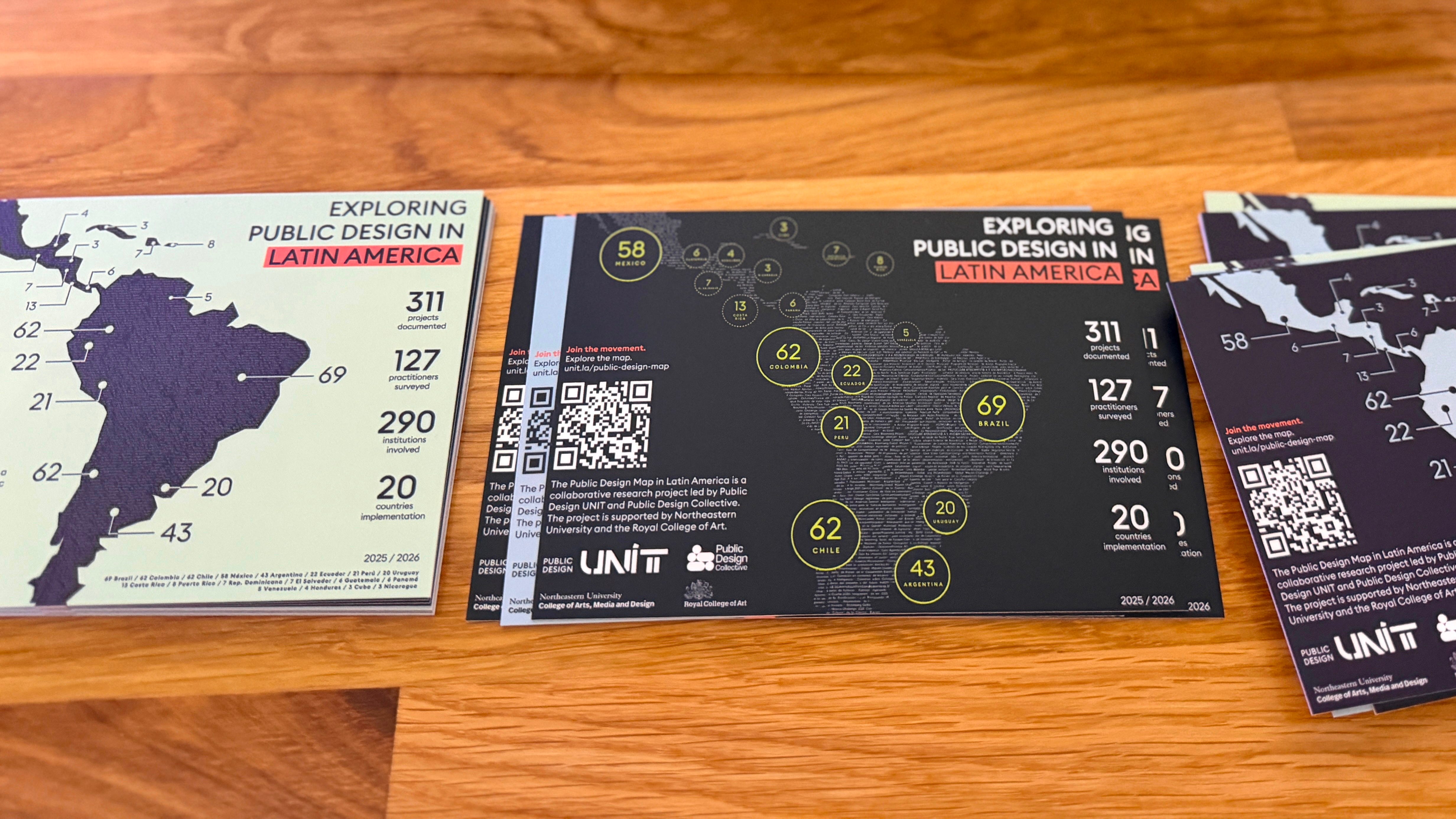
Second, an effort to see our own region clearly: we ran a demonstration of the first map of Latin American public design. Built with a team led by Sofía Bosch from the Public Design Collective at Northeastern University and the Royal College of Art, the Public Design Map documents who is practising public design across the region, from which institutional positions, through which methods, and against what challenges. Its first phase, between October and December 2025, surveyed 127 practitioners across 20 countries in Spanish, English and Portuguese, who reported 311 projects involving 271 institutions.
The map did not create a field; it made one visible — and confirmed a simple, important idea: Latin America already has an active, inventive public design ecosystem. Its problem is not a lack of practice but dispersion. Knowledge stays trapped inside teams, projects depend on political windows, and practitioners face the same challenges without knowing who else is working on them.
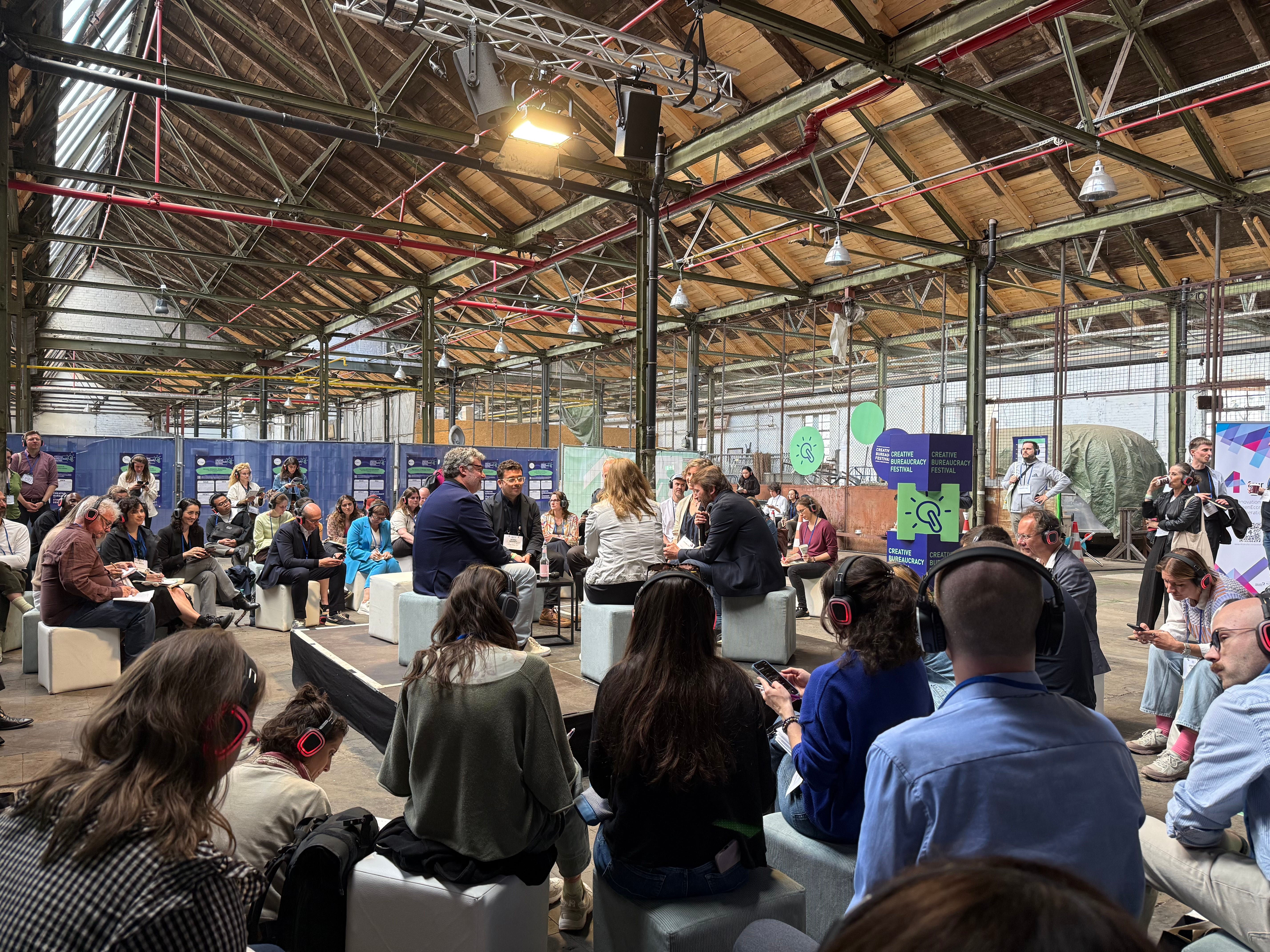
Third, a question about learning: we were part of a fishbowl conversation on public-sector training. This is close to our core, and it produced maybe the most relevant shift in thinking I’ve taken home. My contribution to the panel was a single conviction: this is not really about training — it is about learning. My main intervention argued for shifting the conversation from training to learners. For years the field has asked what curriculum to deliver, what tools to teach, what competencies to certify — we were looking for an answer just on our end.
We are now seeing the value of the alternative starting point: who is the learner, what do they actually need, and what kind of conditions that learning might have to endure once back in a bureaucratic environment that may not be ready for it? Framed that way, the priorities change. You design for identity as much as skill, for communities of practice rather than one-off courses, and for the difficult “re-entry” of a person into their institution — taking seriously that theories imported from elsewhere have to be translated into local realities to survive at all.
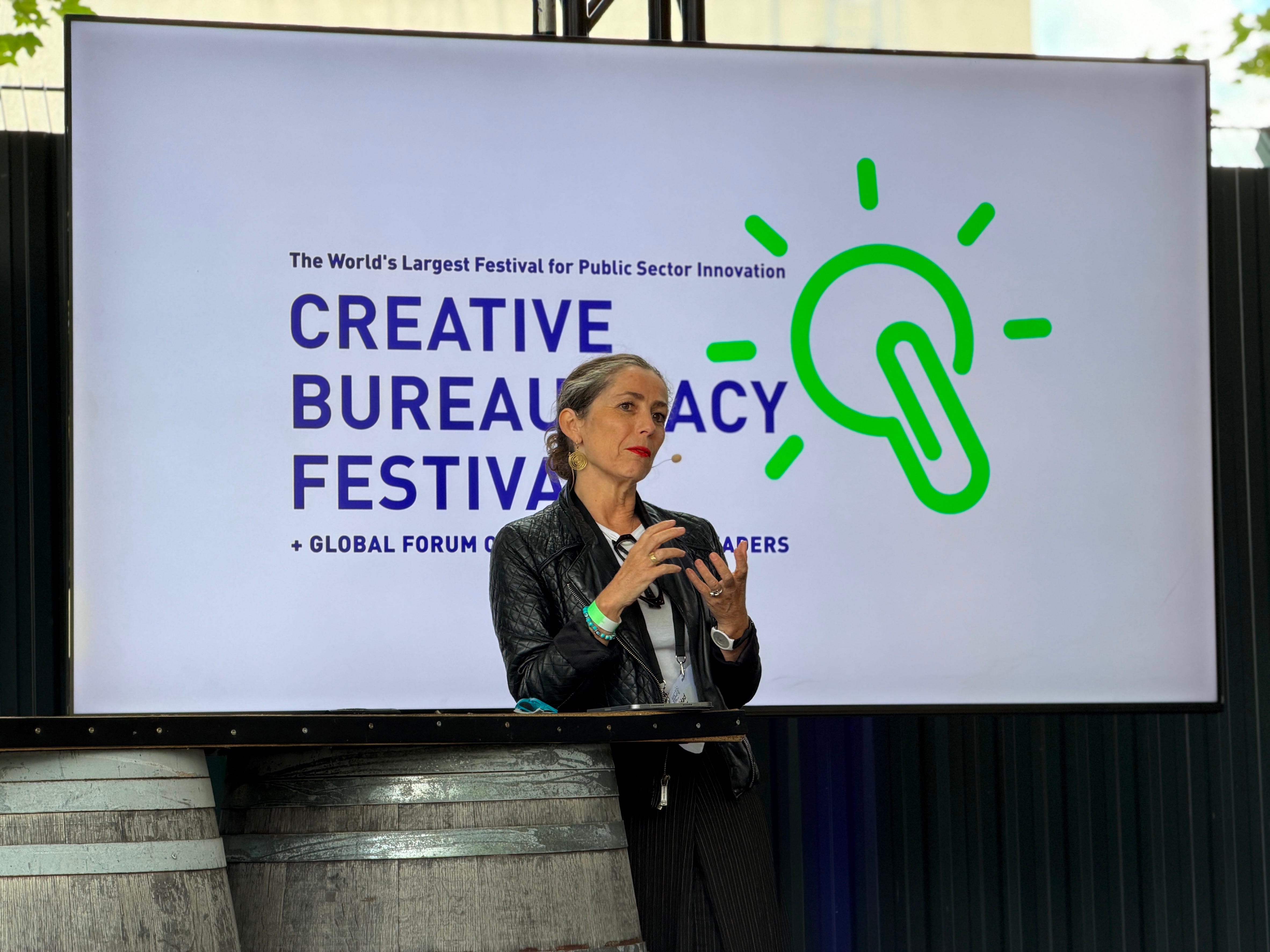
And fourth, a reminder that this happens in cities and cultures, not only inside institutions: we hosted a keynote on creative cities. Trinidad Zaldívar joined our team to build CBF LATAM, and it was in that role that she took the stage in Berlin. Former Head of the Creativity and Culture Unit at the Inter-American Development Bank, she is one of the region’s leading voices on the creative economy as a driver of public value.
Her argument resonates with everything mentioned above: Latin America is not short on creative talent — it is short on bureaucratic muscle. The procurement, funding instruments, and cross-departmental coordination inside city halls have not kept pace with the creative output the region produces. So she flipped the usual question: instead of asking whether city governments can support the creative economy, she asked whether the creative economy can make governments themselves more adaptive, more human, more capable of solving problems that spreadsheets can’t. That is creative bureaucracy in its most concrete form.
Why a Latin American festival — and how it has to work
The infrastructure of public innovation — the gatherings, networks and reference points that shape the global conversation — has long been concentrated in the Global North. Berlin, London, Helsinki. Latin America appears in that conversation, but its practitioners rarely have a regional platform built from their own conditions. Standing at our stand in Berlin, watching people from other continents recognise their own questions in our data, made that gap impossible to ignore.
So the logic of CBF LATAM is a move from mapping to convening. While the map offers the first steps toward a shared account of the field, the festival serves as a meeting point where different approaches can be compared, building trust through a better understanding of commonalities and differences. Our bet is that format is just as important as the content: it cannot be another seminar on state modernisation with four panellists and a slide deck. Following the example of its German counterpart, where where this conversation has run for nearly a decade, it is crucial to foster an interplay of audiences that don’t normally share a room — civil servants, researchers, entrepreneurs, community organisers, mayors — taking the future of the state out of the technical enclosure and into an accessible, public, even enjoyable space where people can actually participate.
Two commitments shape how we’re building it. First, a strong focus on local governments — cities and municipalities are where public services are experienced most directly, and where trust between people and institutions can be rebuilt. Second, this is not a one-day event or a UNIT product; it is a year-long platform and, in the end, a public good — a shared regional infrastructure that many actors help build and use. That is why we’re partnering with the global Creative Bureaucracy network, alongside collaborators like Trinidad Zaldívar.
UNIT’s contributions in Berlin were really four open questions that we will continue to explore in the CBF LATAM: How does our regional practice speak to international practice? Where, exactly, is public design already happening across Latin America and what do its practitioners need in order to keep learning? And what does our understanding of the practice change when we bring into consideration the particular cities and cultures where all this unfolds? A festival is not a place that answers such questions once and for all. It is a place that opens them, in public and together, and keeps them open. That, in the end, is what we are inviting the region to do.
Latin America already has the practitioners, the projects and the methods. What it has lacked is the connective tissue that lets knowledge move across arenas, institutions and borders.
Mapping was the beginning; convening is the next step. It’s the practical form our belief takes: that stronger public institutions are built together, and that a more creative bureaucracy is, finally, a way to a stronger democracy.
Santiago de Chile, 2027. We’ll see you there.
→ Sign up here to receive updates on Creative Bureaucracy Festival Latin America.