



Lee el articulo en español
I wrote a column for Spark, Bloomberg Cities’ newsletter, about why some public innovation teams become indispensable to their cities while others fade away. It’s called “How innovation teams earn (or lose) their seat at the table.” I want to use this space for something different: not to summarise that column, but to have a dialogue with it. To tell you where it comes from, and to open up a discussion that emerged from the comments I received.
I’ll start with something more personal. I’ve spent fifteen years in this sector, since we created Chile’s Laboratorio de Gobierno in 2014 — the first national-level public innovation lab in Latin America. In this time, I’ve seen something that strikes me as more important than any methodology or framework: only now can we talk about power and authority with ease.
Not before. Power was a topic relegated to political science, to the hallways, to conversations that never got written down. In public innovation circles it was almost never mentioned — we talked about human-centered design, prototyping, agile methodologies, but we rarely said out loud that none of that works unless it’s connected to political authority. It was almost a technical taboo: mentioning this dimension sounded like dirtying the work with politics, as if one would contaminate the other.
That has changed — not because someone had an individual epiphany, but because the global public innovation ecosystem matured. We’re now more than a decade into labs, i-teams, and innovation units opening and closing in governments around the world. There’s accumulated evidence, documented failures, generations of practitioners who’ve lived through two or three administrations and seen the full cycle: the team that’s born with fanfare, the one that becomes central, and the one that ends up as an office producing reports nobody reads.
This conversation — about power, about positioning, about why some teams survive a change in government and others don’t — would have been impossible to have five or seven years ago. There wasn’t enough accumulated evidence or critical distance to say it without sounding cynical or naive. Today it can be said in a newsletter read by thousands of people in the sector, and that in itself is a sign that the field has advanced.
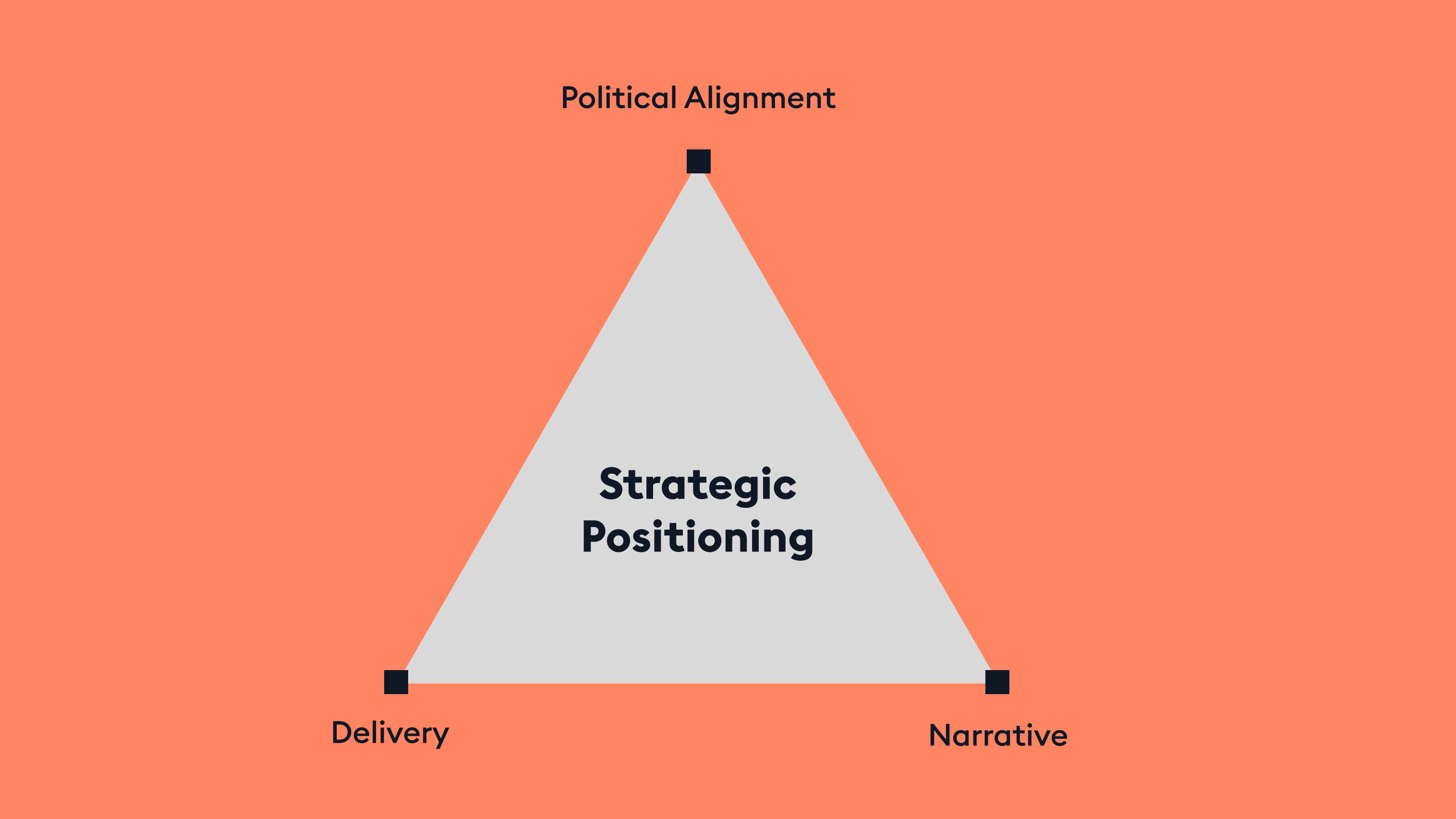
That’s what I tried to capture in the Spark column. The central thesis is simple, if uncomfortable: “the difference [between a team that lasts and one that doesn’t] is almost never a matter of talent.” It’s positioning — where the team sits within the structure of power. This positioning is built from three elements working simultaneously: political alignment, narrative, and delivery of results. When all three are in sync, legitimacy accumulates and survives political transitions. When one is missing, it erodes — sometimes so slowly that no one notices until a new administration arrives and quietly shuts the unit down.
James Anderson, of Bloomberg Philanthropies, put it better than I could in a recent piece for The Creative Bureaucracy: Where Next & How: “in the public sector, big change doesn’t happen at the margins — it happens when innovation aligns with power.” That sentence is, in essence, the entire argument of the column.

That’s the thesis. But the comments I received after publishing it left me thinking about something I’d settled too neatly: talent and capabilities.
The column claims, without much nuance, that talent matters less than positioning. I still believe that in relative terms — I’ve seen brilliant teams get sidelined and mediocre teams survive on pure political positioning. But several people wrote to tell me, rightly, that this claim hides a more difficult question: shouldn’t a genuinely talented team be capable of adapting to complex environments, reading authority, and building a legitimate, sustainable value proposition on its own? If talent includes that adaptive capacity, then separating it so cleanly from positioning is a kind of conceptual sleight of hand.
It’s a good question, and I don’t have a settled answer. But there’s research that helps me think about this with more rigor than my intuition alone. Boris Groysberg, of Harvard Business School, tracked the careers of more than a thousand star Wall Street analysts for years — the best of the best, measured with hard performance data. His findings1: when those star analysts switched firms, their performance dropped immediately and stayed down. What looked like portable individual talent turned out to depend heavily on resources, organizational culture, networks, and colleagues at the original firm. Talent, measured this way, didn’t travel alone. It traveled with the context that made it possible.
Groysberg finds interesting exceptions: analysts who move together with their entire team maintain their performance, as do those who move to objectively better firms. That is, at bottom, my point about positioning, seen from another angle: it’s not that talent doesn’t matter — it’s that talent without the structure that sustains it (the team, the platform, the power around it) delivers far less than it promises.
So maybe my column oversimplifies a relationship that’s more circular than I let on. Positioning doesn’t replace talent; it conditions, amplifies, or wastes it. There’s a specific kind of talent — the ability to read power, to translate technical work into political narrative, to adapt when the environment gets complex — that may be precisely what’s missing from a team that fails despite having brilliant people. That particular talent isn’t the same as technical or methodological talent. Is that capacity to adapt to power a form of talent, or is it actually the first manifestation of positioning itself?
After fifteen years watching labs appear and disappear, here’s what I’m sure of: the conversation that was unthinkable a decade ago — talking about power without shame, in public, backed by evidence — is possible today. That, more than any new methodology, is what gives me hope about where this field is headed.
I’ll leave the debate open, because I don’t have a final answer: Is the ability to read power and translate it into narrative a form of talent, or is it a signal of positioning? We want to know what you think — this is a conversation worth continuing to explore.
Strategic positioning is a topic we'll keep developing over the coming months. Subscribe to get more updates.
Published in the book Chasing Stars: The Myth of Talent and the Portability of Performance (2010).